writing4 min read
Headless CMS Under the Weight of Content
A headless CMS was supposed to free your content from the page. Then AI made content cheap to produce in volumes nobody planned for, and the part that breaks is not storage. It is everything around it.
by faisal kurdi
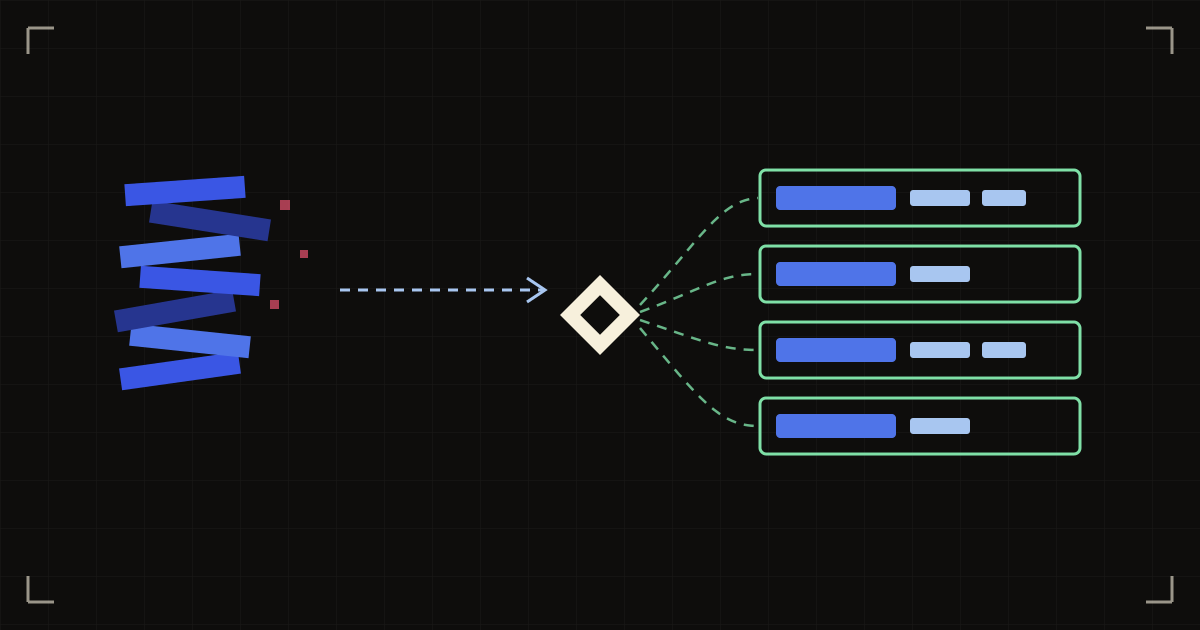
A headless CMS solved a real problem. It pulled content out of the page template and turned it into structured data you could send anywhere, the website, the app, the kiosk, the partner who wants a feed. We have built on that model for years because it is the right shape for a business that publishes to more than one place. What I did not anticipate, and what I now spend real time helping clients with, is what happens to that model when AI makes content cheap to produce in volumes nobody designed the system to hold.
The naive worry is storage, and storage is the part that does not matter. A modern headless CMS will hold a million entries without complaint. The things that buckle under content growth are the human and editorial systems wrapped around it, and AI is pushing on all of them at once.
Volume breaks the parts that were never automated
When a team could produce twenty articles a month, a loose content model worked fine. A few fields, some free text, a category someone picked by hand. The structure was sloppy because a human was always in the loop to make sense of it. Then a model lets that same team produce twenty articles a day, and every shortcut in the content model becomes a fault line. Categories chosen by hand do not get chosen. Metadata that was optional stays empty. Duplicates pile up because nobody can read fast enough to notice. The CMS is fine. The discipline that kept the content usable was doing more work than anyone realized, and volume is where that shows.
This is the first thing I tell clients who are about to point AI generation at their CMS. The bottleneck moves. It used to be producing the content. Now it is governing it, and a system built on the assumption that a human reviews everything will quietly fill with content that no human ever looked at. The structure of the content model, the thing that felt like overhead when volume was low, becomes the only thing keeping the whole library navigable when volume is high.
The same machine that fills it can help govern it
The encouraging half of this is that the tool creating the flood is also the best tool for managing it, if you point it at the right job. A model is very good at the structuring work that humans stopped doing once volume rose. Tagging an entry against a real taxonomy. Flagging a new piece that duplicates an existing one. Pulling the metadata out of free text so the fields stop being empty. Translating one canonical entry into the variants the different channels need. This is unglamorous classification work, and it is exactly where models are reliable.
A headless CMS is unusually well suited to this because the content is already structured data with a schema. The model is not guessing at a blob of HTML. It is reading defined fields and writing defined fields, which is the situation where its output can be validated rather than trusted. The pattern that holds up is to let the model do the structuring and enrichment on the way in, validate it against the schema the CMS already enforces, and keep a human reviewing the judgment calls rather than the volume. The machine handles the scale. The person handles the decisions that scale cannot.
The retrieval problem nobody budgeted for
There is a second reason the content model suddenly matters, and it is newer. A growing share of content is now read by machines, not just people. AI systems that answer questions over a company’s own material live or die on whether that material is structured, current, and free of contradictory duplicates. A headless CMS full of clean, well-tagged, single-source entries is a near-perfect substrate for that. A headless CMS full of AI-generated near-duplicates with empty metadata is a substrate for confident wrong answers, because the retrieval system cannot tell which of the four similar entries is the one that is true.
So the content model is doing double duty now. It keeps the library usable for the humans who edit it, and it determines whether the AI reading it can find the right thing. Both of those reward the same investment, a real taxonomy, enforced structure, and a single source of truth for each piece of content. That investment felt like a nicety when content was scarce and human-read. It is load-bearing now that content is abundant and machine-read.
What this means for how you build
The lesson is not to slow down the content. It is to spend the time you save on generation buying back the governance you used to get for free from scarcity. Tighten the content model before you turn on the firehose, not after. Use the model to enforce structure on the way in rather than cleaning up the mess later. Decide what a single source of truth means for your content and defend it, because abundance without that discipline is just a faster way to fill a CMS with content no one can trust.
A headless CMS handles content growth in the only way that matters, by keeping content structured enough to stay useful at volume. AI is what makes the volume arrive, and AI is what can keep the structure intact if you aim it there. If you are looking at a content operation about to scale faster than its model can handle, that is precisely the problem our headless CMS work is built to get ahead of.